
EDTECH · ENTERPRISE UX · END-TO-END
Replacing email back-and-forth with a self-service registration flow
Customers were missing registration deadlines because a manual, email-driven process stood between them and completing enrollment. I redesigned it as a self-guided digital flow — removing the intermediary entirely.
ROLE
UX Designer & Researcher
INDUSTRY
EdTech / B2B SaaS
PLATFORM
Web (desktop-first)
METHODS
Stakeholder interviews, data analysis, user flows
Self-service
Form design
User flows
Salesforce integration
THE PROBLEM
Registration required too many people and too many emails
Customers — teachers, administrators, and district leads — needed to register their organizations before a school-year deadline. But the process routed through customer service via email: slow, error-prone, and often delayed past the window. Support cases were in the thousands each cycle. The business had been considering a fix since 2022.
RESEARCH APPROACH
Understanding the process before redesigning it
Because direct user access was restricted (school calendars meant users weren't registering during our design window), I sourced insights from the people closest to the problem.
-
Interviewed the sales team to map customer types and registration motivations
-
Spoke with business stakeholders and the business analyst to understand the current flow and vision
-
Reviewed existing support case data for patterns and pain points
-
Conducted competitor research to see how similar platforms handled self-registration
USERS IDENTIFIED
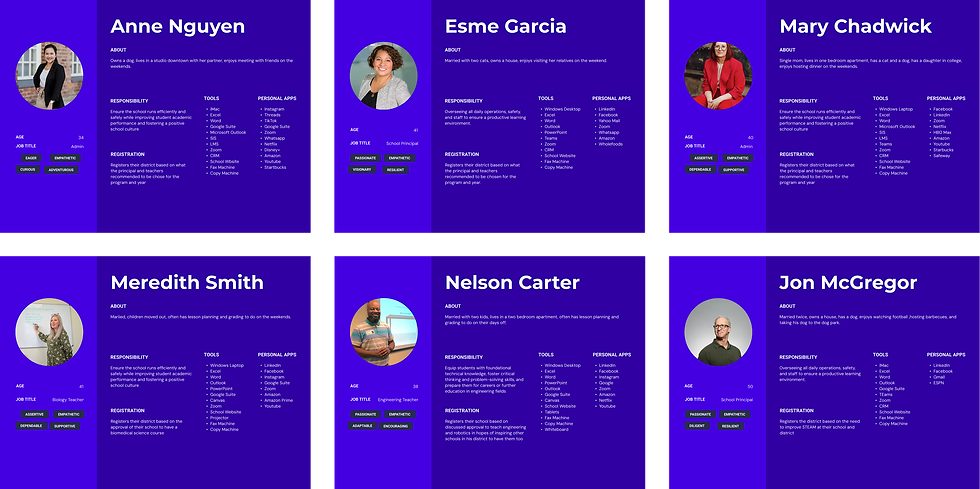
Four registrant types, one shared frustration
Teacher
Registering for their classroom
Primary
Principal
Registering school-wide
Primary
School admin
Managing org details
Secondary
District admin
Registering multiple schools
Secondary
DESIGN PROCESS
Collaborating across disciplines to get the flow right
I worked closely with the business analyst and lead developer to iterate on user flows that accounted for both the frontend experience and backend constraints — SalesForce, business intelligence, and the delivery system. The flow needed to handle multiple registrant types branching from a single entry point.

Original Flow

Redesigned Flow
WIREFRAMING & ITERATION
From high-fidelity wireframes to a tested final flow
Wireframes were developed at high fidelity from the start, given the technical constraints and the need to coordinate with engineering early. Key screens:


OUTCOME
Peak registration, fewer problems
After full self-service launched in 2024, the results were measurable: support cases dropped from thousands to fewer than 20 per cycle, and peak registration saw 433 more organizations compared to the previous year. The system removed the bottleneck without adding friction for users.
40%
Increase in user engagement within the first 3 months
433+
More organizations registered during peak season vs. prior year
< 20
Support cases per cycle — down from thousands
0
Intermediaries needed to complete registration
01
CONSTRAINT
No direct access to end users during the design window — school staff weren't registering during the off-season when we were building.
03
WHAT'S NEXT
A research team has since been established and will gather direct user feedback on the flow for phase two improvements.
02
WHAT I DID INSTEAD
Leaned into proxy research: past support case data and qualitative input from customer service and sales teams who knew users intimately.
04
KEY LEARNING
Proxy research, when done carefully, can yield strong signal. The trick is being honest about the limits of the data.
REFLECTION


